

Iran has responded by closing the Strait of Hormuz, in addition to attacking oil and gas production facilities and the wider infrastructure of other Gulf states.
The rationale and goals for the US & Israeli attacks on Iran remain unclear. President Trump has offered a variety of aims and objectives for launching the offensive and the terms for settlement. He has recently sought to reassure markets that the job is almost complete and that the war will end soon.
Join our new WhatsApp channel: The Morning Round-Up
Get the biggest pub trade stories straight to your phone. Listen to our one-minute daily news briefing and receive breaking news, exclusives and sector updates throughout the day...just remember to turn notifications on in top right!
Join the channel here.
However, the Iranian regime continues to target oil and gas production facilities and the wider infrastructure of other Gulf states, creating the prospect of a global recession, which it hopes will place both domestic and international pressure on the US to stop the attacks and ensure Israel’s co-operation in doing so.
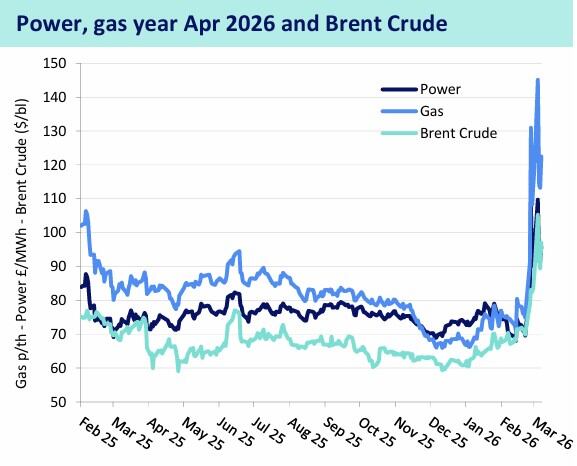
The Strait of Hormuz, the bottleneck through which approximately 20% of global oil and gas flows, remains closed. Assurances of the US’s ability to ensure safe passage are untested, as is Iran’s ability to keep it closed when multi-national forces appear ready to reopen.
European gas reserves remain around 30%, while the UK’s have risen to 35%. Currently, there are no concerns over reserve levels. However, gas commodity movements are more dramatic than electricity, as it is both a fuel itself and the source of 27% of the UK’s and 17% of Europe’s electricity generation.
Business energy costs
While sample contract prices reflect an increase in commodity costs, they don’t reflect the scale of changes. The past few days have seen over 11ppkW for electricity and 5ppkW for gas. Should the crisis continue, we can expect contract rates to rise above 30ppkW for electricity and over 10ppkW for gas.
Non-commodity increases, mainly via standing charges, will add other cost pressures.
These will affect customers who are in contract, as well as those agreeing new contracts. Many will receive a letter from their supplier shortly, confirming the increase in their costs, which customers can do nothing about.
Depending on the supplier and contract, pubs are looking at an increase of £1.50 to £9 per day on current costs.
| Commodity Cost | Av Unit Rate | Av Standing/Ch | ||
|---|---|---|---|---|
| Electricity | 13/02/2026 | 7.6p | 23p | £3.86 |
| 27/02/2026 | 6.9p | 23.1p | £1.52 | |
| 12/03/2026 | 9.6 | 26.5p | £2.00 | |
| Gas | 13/02/2026 | 2.6p | 6p | £1.15 |
| 27/02/2026 | 2.5p | 5.5p | £1.98 | |
| 12/03/2026 | 4.2p | 7p | £1.57 |
While customers who are in contract should not see the conflict impact their energy costs.
Any customer in a new business, or at contract renewal, may be unsure of the best course of action. There is no right or wrong answer.
In September 2021, as commodity costs spiked due to increasing Russian-EU tensions over gas being withheld. Nationwide Energy stopped selling contracts for 10 days. When we returned, we only sold one-year contracts. This approach was entirely focused on what we believed was right for the customer.
However, in retrospect, the best action would have been to recommend three-year contracts. Today, if 7ppkW for gas is tolerable, that cost certainty may be a better solution than waiting for prices in the coming weeks and months, which may be significantly more expensive.
As always, the best course of action is to present all options to the customer and let them decide.
For larger businesses with flexible purchase strategies, future seasons’ purchases are best delayed for several weeks. Prices for all future seasons have increased, far beyond the conceivable impact of this conflict. Should the resolution of military action be based on genuine progress, this should allow commodity costs to fall below those in place prior to the attacks commencing.
Nationwide Energy offers the support you need to make your next energy contract transition smoother, deal with supplier issues, or review your energy consumption.
Contact Nationwide Energy
Tel: 02476 328995
Email: info@nationwide-energy.co.uk


