


At BLOODsports in Covent Garden, a replica of the carpet from The Shining sits beneath more than 30 screens showing live sport and horror films. In Brighton, Crossbar has swapped what its founder calls “sticky floors and shirts pinned to the ceilings” for wine, comfortable seating and a customer base that is more than 90% women. Meanwhile, Canadian operator La Cage has arrived in London with a model where the restaurant is intended to matter just as much as the match.
These concepts look wildly different, but they are responding to the same problem: customers no longer need a pub to watch sport.
Join our WhatsApp channel: The Morning Round-Up
Get the biggest pub trade stories straight to your phone. Listen to our one-minute daily news briefing and receive breaking news, exclusives and sector updates throughout the day... just remember to turn notifications on in top right corner!
With increasingly sophisticated home viewing and access to almost every major fixture, simply having the right game on is becoming the minimum requirement. Operators are instead competing on everything surrounding it, from food, drink and design to entertainment, atmosphere and the communities they cater for.
The result is a new generation of venues attempting to turn a 90-minute fixture into a much broader hospitality occasion, while established sports pubs are being forced to raise their game too.
The Morning Advertiser looks at what is driving the change and where the sports bar goes next.
GOAT: Built around the occasion

GOAT in Nantwich was born from a considerably simpler question: where did its founders actually want to watch sport?
Co-founder Gary Evans said the group felt their home town lacked somewhere that combined a serious sports viewing experience with the food and atmosphere they wanted themselves.
Inspired partly by the scale and energy of American sports bars, the team designed the venue around sightlines, sound, screens and seating, but deliberately avoided creating somewhere that only worked for major football fixtures.
That approach helped GOAT take the Best Pub to Watch Sport title at the Great British Pub Awards 2026.
Its identity extends beyond the technology. Retro sports jerseys, nostalgic references, lighting, music and branding are intended to make the venue immediately recognisable.
“You are competing with people’s living rooms now,” Evans said. “Everyone has a huge television at home. You have to give them a reason to leave the house.”
Part of that opportunity is coming from beyond football.
GOAT has built audiences around boxing, Formula 1, darts and American sport, while its broader programming has stretched as far as sumo wrestling. Tickets for a Super Bowl event, including food and a guaranteed seat, sold out within two days.
Evans believes that fragmentation creates an opportunity for pubs capable of understanding individual sporting communities.
“Sports pubs need to start thinking much more like entertainment venues rather than simply pubs that show sport,” he said.
Ultimately, Evans believes the advantage lies in the collective experience. “The thing a venue can offer that your living room can’t is that shared atmosphere.”
La Cage: Importing the sports dining model

La Cage approaches the same problem from another direction.
Groupe Grandio recently brought the Canadian concept to London, with president and chief executive Jean Bédard arguing changing consumer habits made the UK an attractive market.
“There are plenty of places in the UK where you can watch live sport, but we wanted to create a hub where the food and drink are just as important as what’s on the screens,” he said.
The principle is familiar in North American sports dining: sport drives atmosphere and occasions, but the restaurant needs to stand on its own when there is nothing significant on.
Bédard said relying only on major fixtures would mean building a business around a limited number of occasions.
Instead, La Cage wants customers to visit for lunch, dinner, drinks and celebrations, with sport providing an additional layer.
The Canadian concept has also been adapted for the UK market. Football remains significant, but Bédard pointed to rugby, cricket, tennis, boxing and F1 as important parts of British sporting culture, while the menu has also been developed with local customers in mind.
He believes UK sports bars are already moving towards a more experience-driven model because access to the fixture itself has ceased to be enough.
“The opportunity is now to give people something they can’t access at home: great food, atmosphere, service and a shared experience of watching a game together.”
Ultimately, he said, screens are now simply the minimum requirement. “The winning formula is about community and experience.”
BLOODsports: When sport is only part of the show

Opened in Covent Garden last year, BLOODsports pushes the sports bar into altogether stranger territory, combining live fixtures with horror films, arcade games, dive bar culture and a deliberately immersive identity.
When the Morning Advertiser’s sister site MCA spoke to MEATliquor co founder Scott Collins shortly after Bloodsports opened, he was adamant it was not really a sports bar at all.
Instead, Collins described it as a “watching bar”.
Inspired by dive bars he had visited in Los Angeles, Chicago, New York and Las Vegas, alongside Tokyo’s underground deathmatch wrestling scene, BLOODsports combines more than 30 screens with horror films, karaoke, arcade machines, pool, pinball and a deliberately immersive interior.
The carpet replicates the one seen in The Shining, while the walls combine real and fictional sporting memorabilia. Sport remains important, but customers do not have to engage with it.
“We’re not a sports bar,” Collins said at the time. “There will only be sound on for sport in areas where people specifically book for it. The rest of the space is about music, atmosphere, and entertainment.”
Its late licence also allowed BLOODsports to lean into US fixtures that are difficult to watch elsewhere, while Collins wanted the screens to accommodate anything from boxing to far more obscure competitions.
His criticism of the existing market was equally direct.
“Most pubs that call themselves sports bars are just pubs with a TV on the wall,” he said. “We wanted to create something purpose built where every seat is part of the experience.”
More than a year on, the concept remains a useful early example of how far operators can take the idea once sport becomes part of a wider cultural identity rather than the venue’s only defining feature.
Crossbar: Building a different sports culture
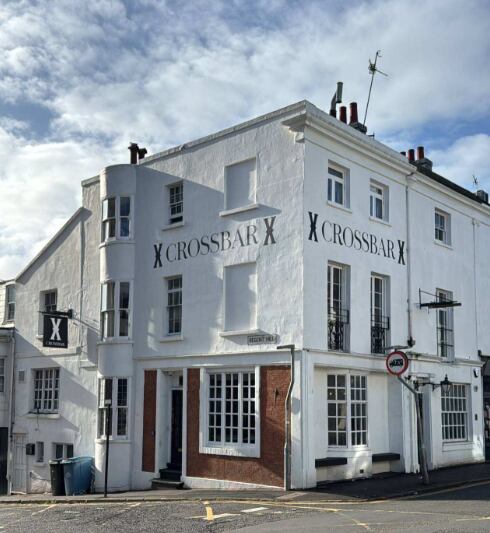
Perhaps the clearest evidence that the audience itself is changing can be found in Brighton.
Crossbar founder Lucy Tallant saw what she described as a “glaring hole” in the UK market for a venue where women’s sport was actively nurtured and women could watch sport in an inclusive environment.
Crossbar deliberately set out to feel different. Tallant describes the concept as an “elevated sports bar”, with comfortable seating and a proper wine list alongside eight high definition screens.
“Less sticky floors and shirts pinned to the ceilings, and more wine list, comfy seating and good hand soap in the bathrooms,” she said.
More than 90% of Crossbar’s customers are women across the week, although Tallant said it also attracts men who follow women’s sport or prefer a more relaxed environment.
The programming stretches well beyond headline football fixtures. Crossbar has shown women’s timbersports, Aussie Rules, Gaelic football, baseball and netball, with the latter attracting particularly engaged crowds.
Tallant believes hospitality is still missing an opportunity around women’s sport, pointing to pubs that remain empty during major women’s fixtures while failing to put the games on.
“More televised sports mean more opportunities for hospitality venues to bring in new and existing audiences,” she said.
Her prescription for the modern sports bar is simple: balance the passionate culture that makes live sport exciting with an environment where a broader audience feels comfortable participating in it.
Rita Ray’s: Making sport feel more inclusive

That opportunity is also emerging in Stockport, where founder Becky Brown opened Rita Ray’s around the idea that customers should not have to choose between watching sport and having a lively, more premium night out.
The venue gives both women’s and men’s sport prominence while offering cocktails, wine and a more polished environment than Brown associated with the traditional sports bar.
Central to the concept is making women feel safe watching sport, while also creating somewhere men can watch women’s fixtures without feeling out of place.
Early trading suggests it has tapped into previously unmet demand.
Brown said Rita Ray’s has been around 10 times busier than expected, while customers who previously would not have considered going to a bar to watch football have found themselves doing exactly that.
“We have heard a lot how people wouldn’t dream of going out to watch the football but have had a great time with us drinking wine and cocktails and found themselves enjoying the sport,” she said.
For Brown, that wider offer is crucial because it turns a 90 minute fixture into a broader hospitality occasion.
She also expects more sports bars to organise themselves around particular communities.
“I think it will generate better atmospheres, as people are there solely to engage and enjoy and feel welcomed, safe and included.”
Famous Three Kings: The sports pub benchmark

For an indication of how much the market has changed, Famous Three Kings in West Kensington provides a useful starting point.
The pub won the Great British Pub Awards Best Pub to Watch Sport title in 2016, 2017, 2018, 2021 and 2022, building its reputation partly around an ability to show multiple sports and fixtures simultaneously.
Martin Hopkins said its size and distinct viewing zones allow different groups to watch everything from football and rugby to F1, boxing, NFL and international sport without competing for the same screen. But even at an established sports pub, expectations have moved on.
“People aren’t just coming in to watch a game on whatever screen happens to be available, they want a really good overall experience and they want to be able to watch their specific sport however niche that could end up being,” Hopkins said.
The pub has invested in UHD screens and upgraded its AV offer, while food, drinks, sound and comfort have become increasingly important.
Hopkins added there was room for both traditional sports pubs and newer, more bar led concepts, provided operators understood their audience.
“The important thing is making sure that whatever you are, you do it properly and give people a reason to come back.”
ETM Sport: Premiumising the proposition

That gap between the traditional sports pub and wider hospitality market was exactly what ETM set out to address when it opened Greenwood in Victoria in 2017.
ETM Sport managing director Colin Sadler said at the time much of the sports pub category remained based around “big TVs, value lager, minimal food offer”, while London’s wider pub and casual dining market had progressed rapidly.
“We didn’t think sport fans should have to choose between watching the game properly and having a genuinely good night out,” he said.
Greenwood combines serious AV and sound with a stronger food and drink offer, interiors and service, and that approach has subsequently been expanded across ETM’s Sport London venues.
Sadler said the audience had also broadened, with more women, international fans, corporate groups and customers who may only be partly interested in the fixture.
As a result, the venue itself has to work beyond sport.
“Every sports bar in London can put the match on, so this is not a point of difference,” he said. “What actually decides where a customer goes, and whether they come back for a Tuesday night game with no big occasion attached, is whether the food is worth ordering, whether the drinks list has some thought behind it, whether the service is warm and quick, and whether the room itself is somewhere they want to spend three hours.”
Football remains the backbone, but ETM has also seen growth around NFL, F1, UFC, boxing and major rugby fixtures, with partnerships including the NFL and Barmy Army.
Sadler expects the gap between strong and generic sports venues to widen further. “Any operators still thinking of this purely as ‘screens and beer’ will get left behind.”
Pinnacle: Turning the fixture into an occasion

In Leeds, Concept Taverns took a similar decision to put sport more decisively at the heart of Pinnacle, rebranding it as Pinnacle Sports & Games in 2024.
Senior marketing and sales manager Olivia Kendall said the original concept “wasn’t quite working”, but sport was already one of the venue’s strongest elements.
The operator built around that strength, changing the food and drinks offer while adding interactive darts alongside its pool tables. The venue went on to win Best Pub to Watch Sport at the 2025 Great British Pub Awards.
Crucially, Pinnacle does not want every customer to spend the entire visit staring at a screen. “The fixture is increasingly becoming the anchor for the occasion rather than the entire occasion,” Kendall said.
Customers might arrive early for food, play darts or pool before kick off, watch the fixture and remain afterwards.
That creates additional dwell time while also making the venue relevant to customers who are not dedicated sports fans.
“There isn’t one type of sports customer anymore,” Kendall added. “Having lots of screens is important, but it’s not enough on its own.”
For Kendall, that leaves little future for the most basic interpretation of the sports bar. “The days of simply putting a few screens up and calling yourself a sports bar are gone.”
More than a match
The concepts may look very different, but operators repeatedly return to the same challenge.
With access to live sport easier than ever at home, the real challenge for operators is giving customers a reason to go out and watch it together.
For Famous Three Kings, that means choice and the atmosphere created by multiple fan communities under one roof. ETM has pushed the category towards premium food, drink and design, while Pinnacle and GOAT are treating a fixture as the centre of a longer social occasion. La Cage is bringing the sports dining model to the UK, Crossbar and Rita Ray’s are opening the category to new audiences, while BLOODsports shows how radically the sports bar can be reinterpreted when sport becomes just one part of a wider experience.
The screen still matters. But increasingly, the successful sports bar is being built around everything that happens in front of it.


